

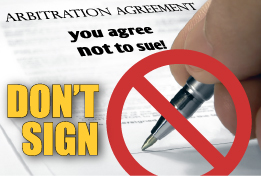
 Plaintiff car buyer filed a putative class action case alleging a defect. The purchase agreement required arbitration, waived class actions, allowed appeals from arbitration awards, consumer pays costs of arbitral appeal, excluded self help remedies to benefit car dealer like repossession from arbitration. The trial court said the arbitration clause was unconscionable as did the Court of Appeal. However, the California Supreme Court reversed!
Continue Reading Proof of Unconscionability of Mandatory Arbitration Agreements is high (Sanchez v. Valencia Holding (2015) 61CA4th 899
Cases holding General Contractor and Developer Liable (“Anti Privette Doctrine”)
 Privette is alive and well, but an injured sub-contractor’s employee can argue the following to try to hold the general contractor or property owner liable. These are for very bad general contractors and property owners who deserve to be nailed.
Continue Reading Cases holding General Contractor and Developer Liable (“Anti Privette Doctrine”)
Cases helping General Contractors, Developers and Property Owners to avoid liability for injuries to subcontractors
 Some strong cases extending the 1993 “Privette doctrine”, Privette v. Superior Court (1993) 5 Cal.4th 689, holding that if an independent contractor’s employee is injured on the job and subject to workers’ compensation coverage, he cannot seek recovery of tort damages from someone who hired the contractor, but did not cause the injury, have been expanded. Plaintiffs still will try to show that the hirer retained control over the cause of the accident. But these cases help refute many of plaintiff’s arguments such as:
Continue Reading Cases helping General Contractors, Developers and Property Owners to avoid liability for injuries to subcontractors
General Contractor’s still “generally” not liable for their sub’s employee’s injuries (“Privette Doctrine” Remains)
 “ Generally, when employees of independent contractors are injured in the workplace, they cannot sue the party that hired the contractor to do the work.” (SeaBright Ins. Co. v. US Airways, Inc. (2011) 52 Cal.4th 590, 594.) This rule has been known as the “Privette doctrine” since 1993 when the Supreme Court decided Privette v. Superior Court (1993) 5 Cal.4th 689, holding that when an independent contractor’s employee is injured on the job and thus subject to workers’ compensation coverage, he cannot seek recovery of tort damages from someone who hired the contractor, but did not cause the injury. Thus, a roofing employee injured carrying buckets of hot tar up a ladder could not sue the property owner for injuries compensable under the workers’ compensation system. But there are some exceptions:
Continue Reading General Contractor’s still “generally” not liable for their sub’s employee’s injuries (“Privette Doctrine” Remains)
Representative Cases
 Representative Cases and Clients of Simkin & Assoc.
(This is a sample of some of the thousands of cases handled.)
- Quiet Title Prescriptive Easement
- Quiet Title unclear deed description
- Partition of Apartment Buildings after dispute between owners.
- Partition House Shared by Brothers
- Encroachment fence and boundary disputes.
- Easement disputes
- Driveway dispute
- Garage Wall dispute
Contracting to exclude “extrinsic evidence” is enforceable. ( Hot Rods, LLC v. Northrop Grumman Systems Corp. (2015) 242 CA4th 1166
 A written contract for the sale of real property included an integration clause stating that “no extrinsic evidence whatsoever may be introduced in any judicial proceedings involving this Agreement.” The referee who tried the case considered such evidence, finding for the plaintiff only to be reversed by the Court of Appeal. Hot Rods, LLC v. Northrop Grumman Systems Corp. (2015) 242 CA4th 1166
Continue Reading Contracting to exclude “extrinsic evidence” is enforceable. ( Hot Rods, LLC v. Northrop Grumman Systems Corp. (2015) 242 CA4th 1166
CCP §473(b) Attorney Affidavit of Fault does NOT require the reason for the mistake to be disclosed. (Martin Potts & Associates, Inc. v. Corsair, LLC (2016) 244 CA4th 432)
 In Martin Potts & Associates, Inc. v. Corsair, LLC (2016) 244 CA4th 432 defendant was defaulted and its long time counsel simply said the failure to respond was his fault but did NOT state the reason for not filing a timely response. The trial court set aside the default and plaintiff appealed. The Second Dist. (Div. Two) affirmed and said mandatory relief means mandatory relief and only needs a declaration from the attorney stating that the default was caused by his mistake, inadvertence, surprise, or neglect. The Court held the reasons for the default do NOT matter, even if the reason is inexcusable neglect
Continue Reading CCP §473(b) Attorney Affidavit of Fault does NOT require the reason for the mistake to be disclosed. (Martin Potts & Associates, Inc. v. Corsair, LLC (2016) 244 CA4th 432)
No Duty to Defend Encroachment Action building fence & trimming Trees (Albert v. Mid-Century Ins. (2015) 236 CA4th 1281
 The court in Albert v Mid-Century Ins. Co. (2015) 236 CA4th 1281 held that an insurer did not have a duty to defend the homeowner in a suit for encroachment arising out of the building of a fence and trimming of trees, because the acts were taken intentionally even if the damage was an accident or unintended result.
Continue Reading No Duty to Defend Encroachment Action building fence & trimming Trees (Albert v. Mid-Century Ins. (2015) 236 CA4th 1281
Equitable Easements require “greatly disproportionate” hardship on the trespasser (Shoen v. Zacarias (2015) 237 CA4th 16
 While it is possible to obtain an equitable easement to allow a trespasser to continue use of the property in exchange for damages, the hardship on the trespasser must be “greatly disproportionate” to the hardship of the landowner losing a portion of her land. In this neighbor dispute over lawn chairs, the Court provided a definition or test to follow adverse to the trespasser. Basically, the Court of Appeal held that the $275 cost to the trespasser to remove the patio furniture was not sufficient compared to the total loss of use of the area to the legal property owner.
Continue Reading Equitable Easements require “greatly disproportionate” hardship on the trespasser (Shoen v. Zacarias (2015) 237 CA4th 16
Gun Restraining Order by family member (Penal Code §18100)
 This is a fairly complicated set of laws. There are three types of “gun violence restraining orders” possible.
(1) A temporary emergency (by police), (2) ex parte (by family member or police) and (3) after notice and hearing (for one year term). There is also a penalty if someone makes a false petition, e.g. a